
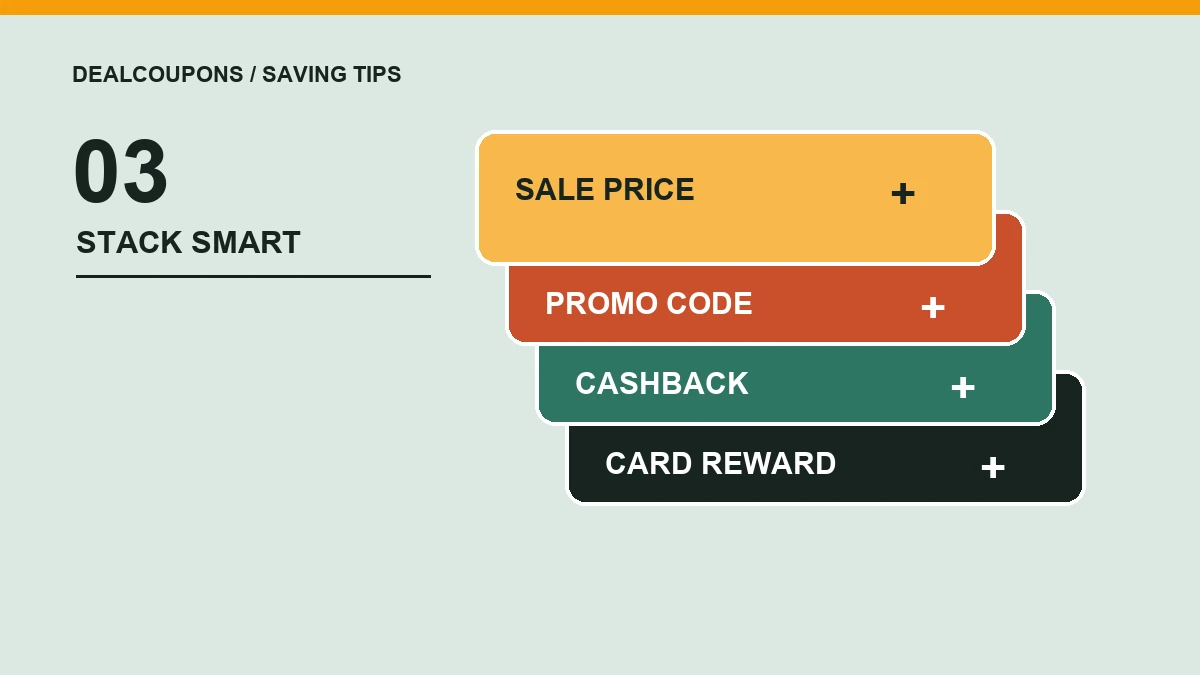
Coupon stacking sounds like a secret checkout trick. It is really just a careful mix of savings that come from different places: perhaps a sale price, one permitted code, store rewards, cashback, and a rewards card. When the rules line up, the layers can add up nicely.
The catch is that every layer has its own terms. What works beautifully at one store may fail at the next, and adding one extra code can sometimes wipe out a larger reward.
What can actually be stacked?
Sale price: The store marks the item down before you enter anything at checkout.
Promo code: A code takes off a percentage, a dollar amount, delivery, or another checkout cost.
Loyalty benefit: A member account may unlock special pricing, points, or a reward certificate.
Cashback portal: A separate shopping site tracks the order and may pay a reward later.
Card offer or rewards card: Your issuer may add points, miles, category rewards, or a statement credit.
Rebate: Some brands and apps issue money back after you submit the purchase details or receipt.
A practical order of operations
- Start with the retailer's rules and the products that qualify.
- Read the cashback terms before choosing a code; outside codes are not always allowed.
- Activate one portal only, then use its link to open the store.
- Build the cart in that same session and enter the permitted code.
- Watch the total change and make sure your store rewards remain attached.
- Pay with the eligible card and keep the confirmation email.
- Handle any rebate afterward, using its own instructions.
Why a promising stack falls apart
- The checkout accepts only one promo code.
- The code does not cover sale or clearance products.
- A loyalty certificate counts as a coupon, not as payment.
- The cashback service does not approve the code you used.
- Another portal or extension replaces the original tracking cookie.
- The card offer excludes gift cards, marketplaces, or outside payment services.
- A return, cancellation, or order change reverses one of the rewards.
What the math can look like
Say an item drops from $100 to $80. A valid 10% code takes the checkout price to $72. You may also earn 4% through a portal and 2% from the card used to pay. That can be a solid stack, provided both programs accept the product and the code.
Do not advertise that as a simple 16% discount. The rewards may be calculated on different amounts, exclude tax or delivery, and arrive weeks after the purchase.
One last look before paying
- The code changed the price of the products you expected.
- The store allows it alongside the current sale or member reward.
- The cashback service lists the code as eligible.
- Only one portal or shopping extension is tracking the visit.
- The payment method meets the card offer's terms.
- You saved screenshots and the confirmation until every reward posts.
The short version: Stacking is less about cramming codes into one box and more about combining savings that are genuinely allowed to work together.